16th Sunday in Ordinary Time
My dear brothers and sisters in Christ,
“This is the day the Lord has made, let us rejoice and be glad in it” ( Psalm 118:24)
On this 16th Sunday of Ordinary time, the Lord told us three parables in the gospel of Mathew 13: 24-43:
- The parable of weeds and the wheat
- The parable of a mustard seed
- The parable of yeast
The theme of divine Justice is highlighted here. The weeds represent those who do evil deeds while the wheat symbolizes good people who love God and their neighbor. At the end of our lives we all will be standing before our merciful Judge our Lord Jesus Christ. The Kingdom of God will continue to grow and grow till the Lord returns.
Let us do our part in building up the Kingdom of God.
EVENING MASS ONCE A WEEK:
I was pleasantly surprised when a young couple approached me with a request for having Mass in the evening once a week for the sake of those who work during the day.
Starting in the middle of August, we will be having an extra Mass on Thursdays in the evening. The daily morning Masses will continue as usual. I hope and pray that our parishioners who work during the day will be able to attend the evening Mass once a week.
POSTURES AND GESTURES AT MASS:
Having completed the walk through the Mass last week, we now concentrate on the postures and gestures which are incorporated in the celebration of the Sacrifice of the holy Mass. It indicates that our whole Being: body, mind and soul is involved in the worship of God.
The Catechism of the Catholic Church, no.1097 says:
“In the liturgy of the new Covenant every liturgical action, especially the celebration of the Eucharist and the sacraments, is an encounter between Christ and the Church”.
Some of the postures and gestures at Mass are:
- Making the Sign of the Cross by touching the forehead, the heart and the shoulders with the right hand at the beginning of the Mass to express our faith in the Triune God.
- Striking our breast during the Confiteor to express or sorrow.
- Bowing during the Creed at the mention of the Birth of Christ and at the name of Jesus.
- Making the sign of the cross with the thumb on the forehead, on the lips and on the heart before the gospel is read to signify that we understand the Word of God, proclaim it with our lips and believe with our hearts.
- Standing: At the start of the Mass, during the Mass and at the end of the Mass.
- Sitting: During the Liturgy of the Word, we sit down and listen to God’s Word in the first and the second readings, at the time of offertory and after receiving the hoy Communion.
- Kneeling: The Faithful kneel during the entire Eucharistic prayer and after receiving the holy communion to thank the Lord in silence.
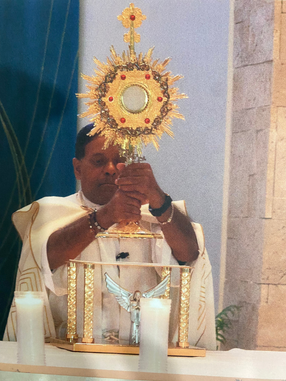
- Genuflecting: As a sign of Adoration, we genuflect by bending our right knee to the floor as we enter and leave the Church. The priest genuflects after showing the Body and Blood of Christ to the Faithful after the Consecration.
- Orans: The priest extends his hands to his sides slightly elevated. This is an ancient prayer posture of the priest indicating praying.
- Singing: We bring our voices together in unison as sing the praises of God.
- Praying in Unison: By praying together the same prayers, we become one Body united in Christ through the sacrament of Baptism.
- Silence: By observing silence during the Mass, we reflect upon the word of God, and to open our hearts to the mystery celebrated.
The Church sees in all these postures and gestures at Mass an ambiguous witness that we are indeed the Body of Christ, united in body, mind and voice.
God bless you!
Fr. Bob Romaine