Solemnity of The Most Holy Trinity
Dear brothers and sisters in Christ,
“This is the day the Lord has made, let us rejoice and be glad in it”. (Psalm 118:24)
Having completed the Easter Season last Sunday, we are now again back to Ordinary time of the year in our Liturgical Calendar. During Ordinary time, we reflect upon the Lord’s teaching through the parables, the miracles and His continued invitation to repentance and conversion of our hearts and minds.
This weekend we celebrate the Solemnity of the Most Holy Trinity.
We believe that God is One God in three Persons: The Father, The Son and The Holy Spirit. We begin the day and all the liturgies in the name of the Trinity and also conclude them in the name of the Trinity. Even though we cannot fully comprehend the doctrine of the Most Holy Trinity, we believe with our hearts.
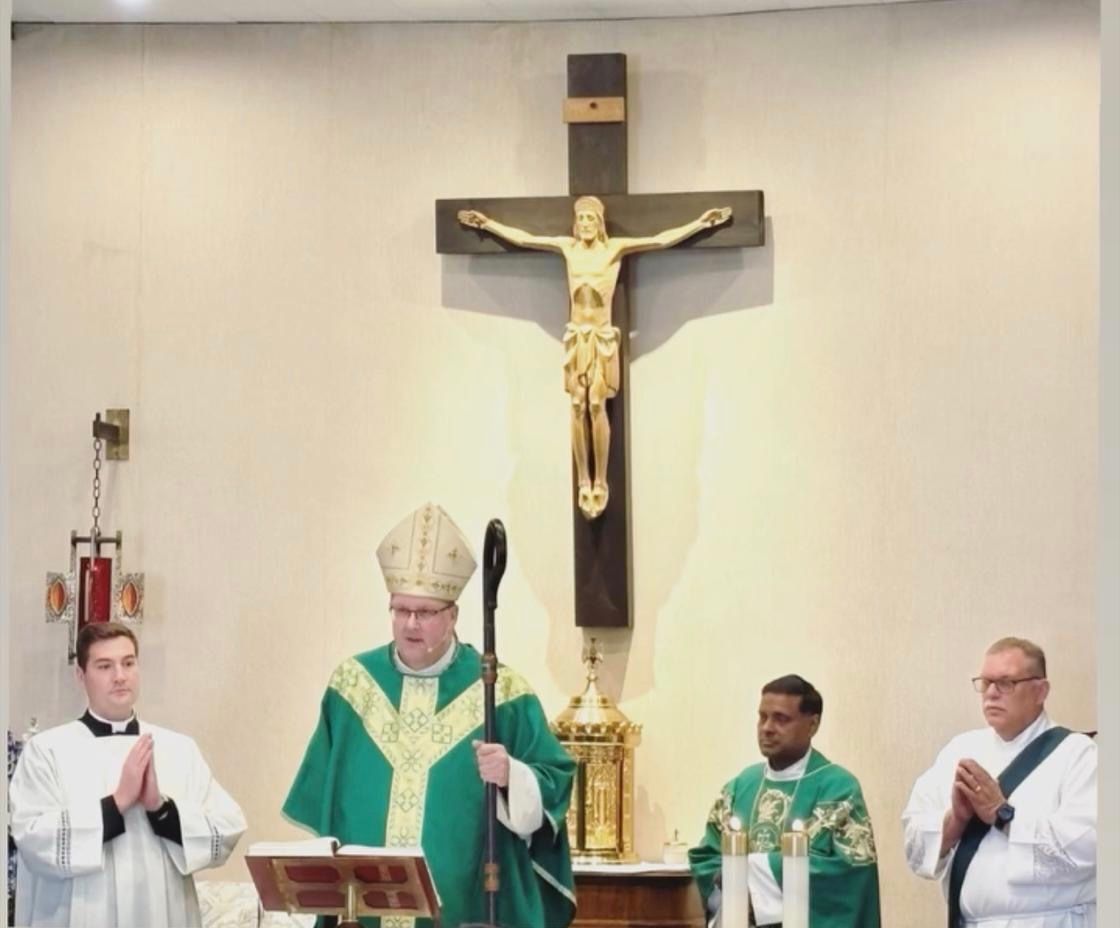
We congratulate four of our teenagers who will be receiving the Sacrament of Confirmation administered by our Bishop, the Most Reverend Gregory Parkes, at St. Rita Catholic Church, Dade City, FL, this weekend during the Holy Mass on Sunday at 11 am. I will be concelebrating that Mass.
I thank their teacher Dr. Thomas Humphries, for preparing them for Confirmation and Terry Pawlicki, the Director of Religious Education in our Parish for her dedication and leadership.
WHAT HAPPENS AT MASS?: A WALK THROUGH THE MASS:
This weekend we highlight the second part of the Mass in our catechesis of the Holy Mass: The Liturgy of the Word.
The General Instruction of the Roman Missal (GIRM) says:
“When the Sacred Scriptures are read in the Church, God himself speaks to his people, and Christ, present in his Word, proclaims the Gospel.” (GIRM, no.29)
We hear the Word of God from the Bible which is the Sacred Scripture written under the inspiration of the Holy Spirit.
On Sundays and Solemnities there are three readings. The first and the second readings are proclaimed by lectors while the third reading, which is from one of the four Gospels, is proclaimed by a priest or deacon. Most of the time, the First Reading is from the Old Testament. It is only during the Easter season that the First Reading is taken from the Acts of the Apostles in the New Testament to give us insight into how the early Church started after the Lord’s Resurrection, Ascension and Pentecost. The First Reading is followed by a Responsorial Psalm which is a prayer of ancient Israel.
The Second Reading is proclaimed from the New Testament letters of St. Paul, St. Peter, St. John, St. James or the Book of Revelation. It is an instruction to the Church on how to live the light of Christ.
Then there is the Gospel acclamation during which the congregation stands to sing the Alleluia (except during Advent and Lent) as a sign of joy and readiness to listen to the Gospel. The Gospel reading is the highpoint of the Word of God, recounting the life, the teachings and the miracles of Jesus Christ, the Son of God.
After the Gospel, the priest or deacon gives a homily, explaining the readings and applying them to our daily life. Then the congregation stands to profess their faith by reciting the Nicene Creed on Sundays and Solemnities.
The Liturgy of the Word concludes with the Prayer of the Faithful, which may include prayers for the world, the Church, local needs, the faithful departed and other intentions.
God bless you!
Fr. Bob Romaine