6th Sunday of Easter
My dear brothers and sisters in Christ,
“This is the day the Lord has made, let us rejoice and be glad in it.” (Psalm 118:24).
The Lord, in the Gospel of John 14:15-21, says that whoever keeps His commandments is the one who loves Him. It is an invitation for us to reflect upon the virtue of obedience.
So what is the definition of obedience?
Obedience is defined as the submission of one’s will to the will of one’s superior. In other words, it is the submission of our personal will to God, the Divine Authority. God is happy when we obey His commandments. It is a way of acknowledging the authority of God who gave us life and endowed us with gifts and talents. In the Old Testament, the people of Israel broke the commandments of God the Father, Yahweh, time and again which made God angry.
The prophet Samuel told King Saul that “Obedience is better than sacrifice.” (1 Samuel 15:22 ).
In the New Testament, Jesus Christ ranks first and showed the ultimate obedience as the one who, by His death on the Cross, obeyed His Father. That is why Jesus is called the Beloved Son of God. The Blessed Virgin Mary ranks second in obeying God the Father when she accepted God’s plan of salvation through the Archangel Gabriel’s annunciation in the following words:
“Behold, I am the handmaid of the Lord. May it be done to me according to your word” ( Luke 1:38 ).
The members of the Clergy and the Religious take a vow of obedience to their Superiors in their service to God’s people and as a way of perfection. May we imitate the Blessed Virgin Mary in our obedience to God. Let us teach our children the virtue of obedience to their parents, teachers and those in authority. This weekend we celebrate Mother’s Day. We wish all mothers a Happy Mother’s Day as we pray for their happiness and well being. The first Communicants will be crowning the Blessed Virgin Mary at all Masses.
WHAT HAPPENS AT MASS: A WALK THROUGH THE MASS
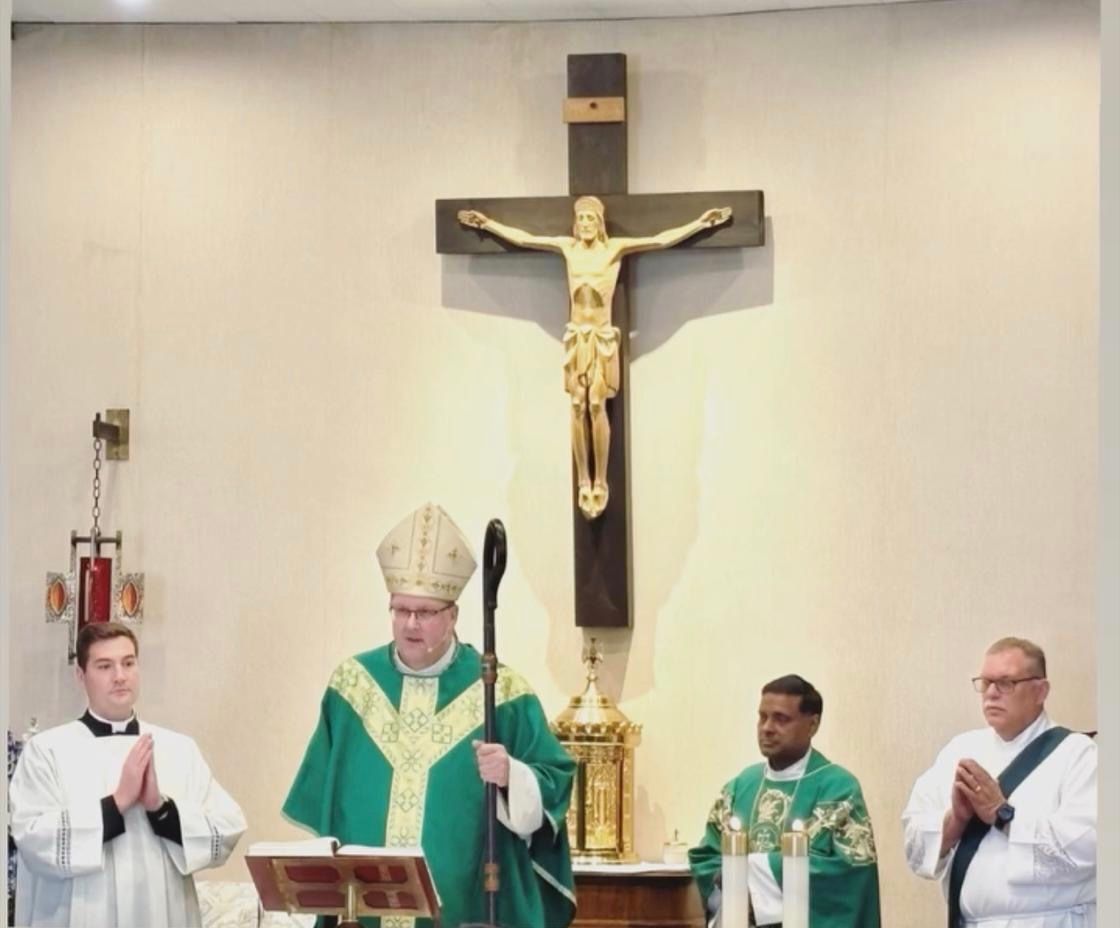
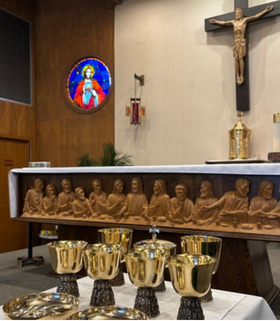
We continue with the Catechesis of the Holy Mass this weekend by highlighting the presence of the following objects in the sanctuary:
1. The tabernacle:
It is a structure or box in which Holy Communion, the Body of Christ, the holy of holies is placed. A light is always burning next to the tabernacle, indicating the real presence of Christ in the tabernacle.
The word ‘tabernacle’ means “dwelling place”. It refers to the ‘tent of meeting’ built by Moses in Exodus 26, for the worship of God by the Israelites.
2. The altar:
The altar is the table on which the Eucharistic sacrifice is offered. It is the centerpiece, the focal point of the Eucharistic liturgy. The altar is usually made up of either wood or stone.
Lighted candles are placed on the altar during the Eucharistic celebration.
3. The ambo:
The ambo is an elevated stand for proclaiming the Word of God during the liturgical celebration. The priest proclaims the Gospel from this stand and also typical gives his homily from the ambo.
God bless you!
Fr. Bob Romaine